
Ben Stopford
Depth Counselling & Psychotherapy
Ben Stopford
Depth Counselling & Psychotherapy
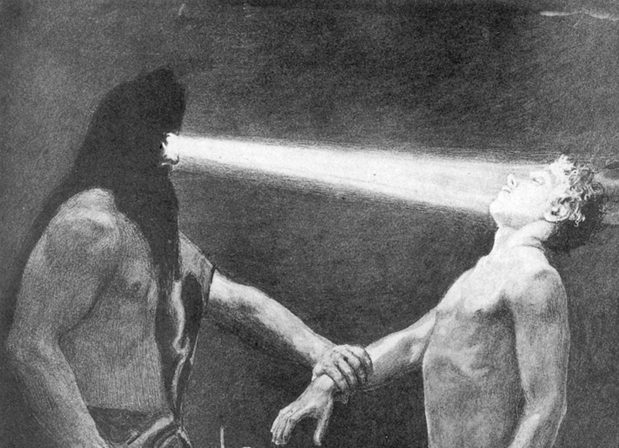
"One does not become enlightened by imagining figures of light, but by making the darkness conscious."
— Carl Jung
What Is the Shadow?
The Shadow is one of Carl Jung's most influential and misunderstood ideas. It does not refer to the "dark side" of personality or to moral failings. Rather, the Shadow encompasses everything within us that has been excluded from conscious identity—qualities, emotions, desires, talents and vulnerabilities that we have learned, for one reason or another, not to recognise as our own.
Some aspects of the Shadow are difficult: anger, envy, selfishness or fear. Others are surprisingly positive. Creativity, confidence, sexuality, ambition, tenderness or playfulness may also become shadow qualities if they were discouraged in childhood or rejected by our family or culture.
The Shadow is therefore not a place of evil, as it is in modern Christian traditions. It is a place of unlived life.
Jung observed:
"Everyone carries a shadow, and the less it is embodied in the individual's conscious life, the blacker and denser it is."
Depth psychotherapy does not seek to eliminate the Shadow. It seeks to bring it into relationship with consciousness, where it can become a source of vitality rather than unconscious repetition.
Why We Develop a Shadow
No child can express every part of themselves and still belong.
Every family, school and culture communicates—sometimes explicitly, often implicitly—which emotions and behaviours are acceptable.
A child may learn:
"Don't be angry."
"Always be good."
"Don't be weak."
"Don't disappoint people."
The developing personality adapts. The acceptable qualities become part of the Persona—the social self. The unacceptable qualities disappear into the Shadow. This process is universal. Without it we could not function socially. The difficulty arises when these disowned parts remain unconscious for decades, quietly influencing relationships, decisions and emotional reactions.
The Shadow in Everyday Life
Most of us encounter our Shadow not by looking inward but by reacting outward. The colleague who irritates you beyond reason. The politician you cannot stop thinking about. The friend whose confidence feels unbearable. The family member who seems impossibly controlling.
Sometimes these reactions are justified, but sometimes their intensity tells us something else is happening. Jung described projection as one of the psyche's primary ways of avoiding self-knowledge. Rather than recognising a quality in ourselves, we experience it as belonging entirely to someone else. We do this with shadow, but with gold too!
The person who prides themselves on always being generous may secretly resent their own unmet needs.
The endlessly agreeable person may carry enormous unacknowledged anger.
The Shadow does not disappear because we ignore it. It simply finds other ways to express itself. Some call this 'leaky' shadow.
The Shadow in Stories We Love
One reason Jung's ideas continue to resonate is that they are visible throughout mythology, literature and cinema. Stories often externalise what psychology describes internally. In The Lion King, Scar is not Simba's enemy. He represents the destructive potential that Simba must ultimately confront within himself: resentment, fear, avoidance and the temptation to abandon responsibility. Only by descending into exile, facing guilt and returning transformed can Simba become king.
Perhaps no modern story illustrates the Shadow more powerfully than Luke Skywalker's confrontation in The Empire Strikes Back. Inside the cave on Dagobah he fights Darth Vader, only to discover his own face beneath the mask. The message is unmistakably Jungian. The greatest danger is rarely outside us. It is the unconscious possibility within. George Lucas openly acknowledged Joseph Campbell's influence on the Star Wars saga, and Campbell's work was itself deeply indebted to Jung's understanding of myth and transformation.
In Harry Potter Lord Voldemort is not merely Harry's opposite. They are psychologically intertwined; their shared wand cores, mental connection and mirrored histories suggest that identity develops through confronting what we most fear becoming.
The Shadow is never completely separate.
It is intimately connected with the development of character.
As Aleksandr Solzhenitsyn wrote:
"The line separating good and evil passes not through states, nor between classes, nor between political parties either—but right through every human heart."
This insight echoes Jung's psychology remarkably closely.
The Shadow and Dreams
Dreams frequently reveal Shadow material before we are ready to recognise it consciously. The Shadow often appears as:
These figures are rarely invitations to fear. More often, they ask to be understood. Jung believed dreams compensate conscious attitudes. If we see ourselves as endlessly competent, dreams may reveal vulnerability. If we identify as kind, dreams may reveal aggression. If we pride ourselves on independence, dreams may reveal dependence.
I often find that Shadow dreams become turning points in therapy. Rather than predicting the future, they reveal neglected aspects of the present.
The Shadow and Relationships
Few places expose the Shadow more quickly than intimate relationships. Partners often become containers for disowned parts of ourselves. We may accuse another person of being:
Sometimes these perceptions are accurate. But depth psychology invites another question:
Why does this particular quality evoke such a powerful response in me?
Marie-Louise von Franz observed that people become psychologically "possessed" when unconscious contents remain unexamined. Relationships therefore become opportunities not simply to understand another person but to discover ourselves.
The Creative Shadow
One of Jung's most hopeful insights is that the Shadow contains not only pain but possibility.
Many people hide artistic gifts, leadership, sexuality, confidence, ambition, tenderness, humour & spirituality. These qualities may have been discouraged early in life.
James Hollis writes:
"Much of what we call personality is the accumulation of strategies developed to avoid anxiety."
The tragedy is not only that we repress difficult emotions. We often repress our greatest capacities.
The Cultural Shadow
The Shadow exists not only within individuals but within societies and groups. Every culture develops ideals while pushing contradictory realities into the background. The philosopher René Girard explored how communities often preserve their own sense of innocence by projecting conflict onto scapegoats. Jung similarly warned that what remains unconscious in individuals can become magnified collectively.
When a society insists it is entirely rational, it may neglect imagination. When it worships productivity, it may repress rest. When it values constant positivity, grief and vulnerability become difficult to express. John Vervaeke's work on the meaning crisis suggests that many contemporary people experience profound fragmentation because symbolic and communal structures capable of integrating these tensions have weakened. Shadow work therefore has both personal and cultural significance.
Integrating the Shadow
Shadow work is frequently misunderstood. It is not confession, self-criticism or becoming less moral.
It is becoming more whole.
Jung called this process individuation, often represented symbolically by the mandala.
Integration begins through curiosity. Questions such as:
"What qualities consistently irritate me?"
"Which emotions do I avoid?"
"What parts of myself feel unacceptable?"
often reveal the edges of the Shadow.
As Robert A. Johnson wrote:
"The brighter the light, the darker the shadow."
So psychological maturity is not achieved by becoming perfect. It emerges through developing a relationship with everything we are.
The Shadow in Psychotherapy
The Shadow rarely becomes visible through insight alone. It reveals itself in conversations, relationships, dreams, emotional reactions and the therapeutic relationship itself. Depth psychotherapy offers a place where these hidden patterns can gradually emerge without judgement. We may explore recurring relationship dynamics, dreams and symbolic imagery, childhood adaptations, shame and self-criticism, unconscious defences, creativity that has gone underground & questions of identity and purpose
The aim is not to eradicate the Shadow but to reclaim the energy that has become trapped within it.
Over time, what once appeared frightening often becomes one of the deepest sources of vitality, compassion and authenticity.
Further Reading
Related Pages
Explore the Shadow Through Psychotherapy
Many of the difficulties that bring people to therapy—repeating relationships, persistent anxiety, emotional numbness, burnout, perfectionism, or a sense of living someone else's life—can be understood through the lens of the Shadow. Often, what we experience as "the problem" is also an invitation to recover neglected parts of ourselves.
In my practice, I work from a depth psychotherapy perspective informed by Jungian psychology, dream analysis, mythology and existential thought. Together, we explore not only symptoms but the symbolic patterns beneath them. Dreams, stories, emotions and relationships all become ways of listening to the deeper movements of the psyche.
The Shadow is not an enemy to defeat. It is an invitation to become more fully yourself. Often, the very qualities we fear or reject contain the seeds of greater freedom, creativity and meaning.
We need your consent to load the translations
We use a third-party service to translate the website content that may collect data about your activity. Please review the details in the privacy policy and accept the service to view the translations.